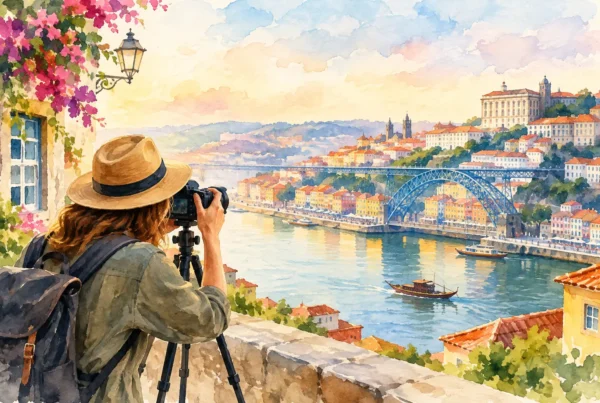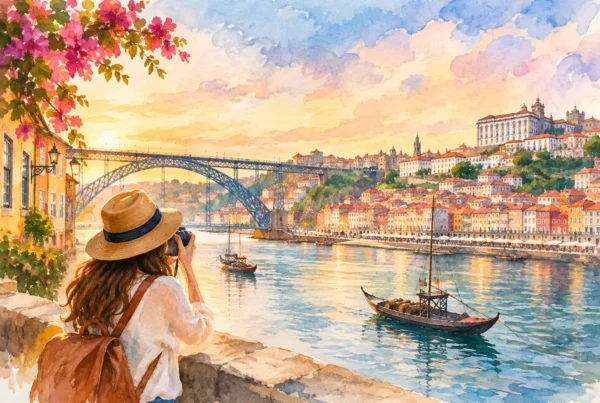

A Porto editorial photographer is not there to turn a trip into a sequence of posed proof that you were there. The work is about noticing the way you reach for each other while crossing a tiled square, the pause before dinner by the river, or the wind catching a dress on a quiet hill above the city. The best images do more than show Porto. They bring back the feeling of being in it.
For couples, families, and solo travelers, editorial photography offers a more considered alternative to a quick set of landmark portraits. It takes the visual language of a magazine story – atmosphere, composition, detail, and a sense of place – and makes room for your actual experience. No forced poses, no need to perform a version of yourselves that does not feel true.
Editorial is a way of seeing, not a costume
People sometimes hear “editorial” and picture high-fashion styling, rigid direction, or a camera constantly asking them to look serious. That can be part of an editorial shoot, but it does not have to be. For travel photography, the word is more useful when it describes intention.
An editorial approach pays attention to the whole frame. It notices the curve of iron balconies behind you, the blue-and-white pattern of azulejo tiles, the changing color of the Douro, and the small gestures that make a photograph personal. Rather than separating you from the city, it places you naturally within it.
That balance matters. A beautiful background alone can feel like a postcard. A close portrait alone could have been made anywhere. When the scene and the people belong together, an image becomes a memory with a pulse.
Why a Porto editorial photographer plans differently
Porto rewards people who slow down. Its steep streets, old facades, river views, and sudden pockets of quiet are full of visual contrast, but they are not interchangeable backdrops. Light moves quickly between narrow lanes. Popular viewpoints can become crowded. A location that is perfect for a wide city view at sunrise may feel flat or busy by midafternoon.
This is where local knowledge changes the experience. The goal is not to race through every famous place. It is to choose a route that suits the mood of the session, the season, and the way you naturally move together. A honeymoon couple may want early golden light along the Ribeira before the streets fill. A family with young children may need an open space, room to explore, and a pace that does not ask anyone to stand still for too long.
For a solo traveler, the right setting might be less obvious: a quiet bookshop-adjacent street, a café window, a textured wall warmed by late-day sun, or a viewpoint that gives the image space to breathe. These choices are not about hiding Porto’s icons. They are about using them with purpose.
Light is part of the story
Portugal’s light can be bright, reflective, and wonderfully clear. It can also be soft and silver after rain, with wet stone catching the city around you. Neither is a problem. They simply tell different stories.
A polished editorial result is not dependent on a cloudless forecast. Strong midday sun may call for shaded streets, interiors, architectural lines, or a more graphic approach. A misty morning can make the Dom Luís I Bridge feel cinematic. In the Douro Valley, low evening light can reveal the shape of terraced vineyards in a way that noon never will.
The useful question is not, “Will the weather be perfect?” It is, “What will this day feel like, and how can the photographs honor it?”
You do not need to know how to pose
Most people are not uncomfortable in photographs because they are bad at posing. They are uncomfortable because they have been told to freeze, smile on command, and somehow look natural while doing neither.
A relaxed session has gentle direction, not silence. You may be asked to walk slowly, lean into your partner, look out at the river, or take a moment to talk about the best part of your trip so far. These are simple prompts, but they create movement and give your attention somewhere real to go.
Then there is room for what cannot be directed: a laugh that arrives unexpectedly, a child running ahead, a hand finding another hand, a private look shared after the camera has faded into the background. Those are often the photographs people keep returning to years later.
There is a trade-off worth understanding. A fully candid approach can feel wonderfully free, but it may not deliver the clean, composed portrait you want for a holiday card or an anniversary announcement. A more directed editorial session can create those strong frame-worthy images while still leaving space for life to happen. The best fit usually includes both.
The details carry as much weight as the view
Travel memories are rarely made from a single grand scene. They live in the details: espresso cups on a marble table, a hand resting on a weathered railing, a jacket thrown over a shoulder, market flowers, polished shoes on cobblestones, the label on a bottle opened after a long day.
These quieter photographs give a gallery rhythm. They also make the final collection feel less like a set of portraits and more like a visual record of a place and a time. When you look back, you remember not only what Porto looked like but how it unfolded around you.
This is especially meaningful for proposals. The obvious moment matters, of course, but the anticipation matters too. The walk toward the location, the nervous glance, the first seconds after the answer, and the relief that turns into laughter are all part of the story. Discretion is essential, but so is knowing when to step close and when to let the moment remain yours.
What to wear without looking overstyled
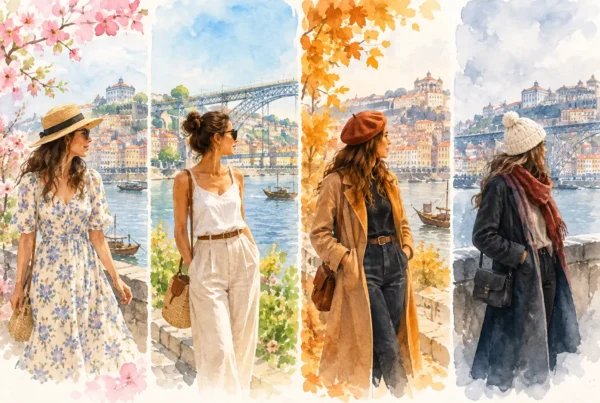
Choose clothes that feel like you, only slightly more intentional. Movement photographs beautifully, so fabrics that catch a breeze or fall naturally tend to work well. Layers are useful in Porto, where an afternoon can change quickly near the river, and comfortable shoes matter far more than most people expect on the city’s hills.
Color is not about following a strict palette. Soft neutrals, earth tones, muted blues, and warm shades often sit beautifully against stone, tile, and greenery. But a red dress, a favorite patterned shirt, or a piece with personal meaning can be exactly right if it feels honest. The aim is not to blend into the scenery. It is to look like yourselves within it.
Try to avoid clothes that make you self-conscious or require constant adjustment. If you cannot breathe, walk, sit, or hold your child comfortably, that feeling will find its way into the images.
When the Douro Valley becomes part of the frame
For travelers with more time, the Douro Valley offers a completely different visual tempo. Porto is layered, urban, and full of texture. The Douro opens outward: vineyard terraces, winding roads, still water, and a horizon that invites you to slow down.
A session there can be built around a vineyard visit, a private wine experience, or simply the changing light across the valley. It works particularly well for anniversaries, engagements, and couples who want photographs that feel spacious and quietly cinematic. It does require more planning than a city walk, especially around travel time, reservations, and the season. That extra intention is often what makes the day memorable beyond the photographs themselves.
Let the photographs feel like your trip
A strong editorial gallery should not make you wonder who those polished people are. It should make you remember the temperature of the air, the sound of the street below your hotel, the wine you ordered twice, and the person beside you when you saw the city from above.
That is the value of choosing photography that leaves room for real connection. Bring the clothes you love, allow enough time to wander, and resist the urge to make every frame perfect. Porto already has texture, light, and stories in abundance. Your only job is to be present enough to become part of one.