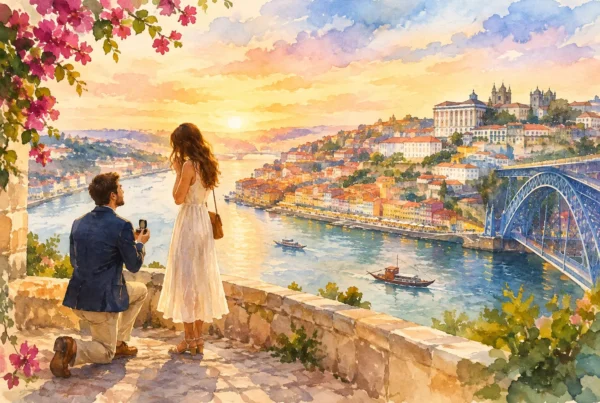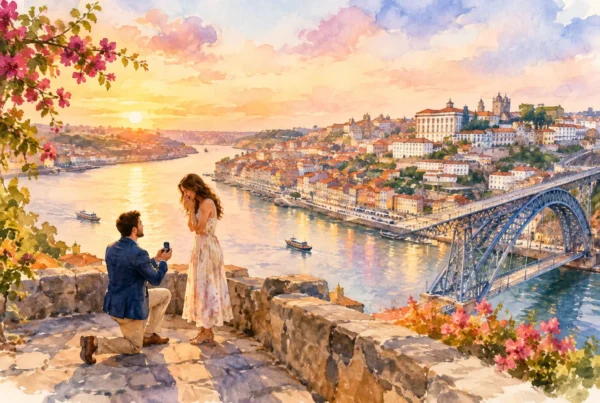

A couple can be wildly in love and still freeze the moment a camera appears. One person laughs too loudly, the other asks where to put their hands, and suddenly a walk through Porto feels like a performance. Learning how to photograph shy couples begins with changing that feeling. Your job is not to make them act natural. It is to create enough ease that they forget they are being watched.
The best photographs rarely come from perfect posture. They come from the small pause before a kiss, a hand finding the other hand, or the look they exchange after sharing an inside joke. For shy couples, those moments need room to arrive.
Start Before the Camera Comes Out
A relaxed session starts before you meet. Ask a few questions that have nothing to do with poses: Why are they traveling? Is this a honeymoon, an anniversary, a proposal trip, or simply a few days away together? What do they genuinely enjoy doing side by side?
Their answers shape the session better than a long mood board. A couple celebrating ten years together may feel most like themselves over a slow glass of wine. Two newly engaged travelers may want a quiet morning walk near the river before the city fills up. When the plan reflects their real rhythm, the camera becomes part of an experience rather than the reason for it.
It also helps to set expectations plainly. Tell them they do not need to know how to pose. They do not need to look at the lens all the time. They will be guided when needed, but they will not be asked to perform romance on command. That reassurance removes a surprising amount of pressure.
How to Photograph Shy Couples: Begin With Movement
Standing still is often the hardest thing for camera-shy people. Movement gives their bodies something honest to do and takes attention away from whether they look right.
Start with an easy walk. Keep the pace slow enough for conversation, then step back and let them move through the scene without constant instruction. On Porto’s cobbled streets, this can be as simple as asking them to walk toward a patch of light, then turn back when they reach it. Along the Douro, let them stop naturally at a viewpoint rather than planting them at its center.
Give prompts, not poses. Instead of saying, “Put your hand here and tilt your chin,” offer a small action: ask one partner to lead the other somewhere they think is beautiful, or ask them to lean in and tell each other what they noticed first that day. A prompt has a destination, but it leaves room for personality. One couple will become playful. Another will grow quiet and close. Both are worth photographing.
Movement should not become a trick you repeat every five minutes. If they are naturally calm, too much walking or spinning can feel just as forced as a formal pose. Watch their energy. The goal is comfort, not activity.
Build Trust in Small, Unhurried Moments
Shy couples often need proof that the session is safe before they give you anything real. Do not start at the busiest viewpoint with a crowd at their backs. Choose a quieter corner first, take a few low-pressure frames, and show them that there is no wrong way to be together.
Your own pace matters. If you rush to fill every silence with directions, they will assume they are failing. Allow breaks. Let them look around. Ask about the restaurant they loved the night before or the neighborhood they want to return to. Conversation is not filler. It is part of the work.
Keep your feedback specific and warm. Rather than saying, “That was great,” tell them what you saw: “The way you both looked at each other when you started laughing was beautiful.” It teaches them that the photographs are about connection, not about getting their expression technically correct.
Choose Places That Offer Privacy and Purpose
A location can either support a shy couple or put them on display. Grand landmarks have their place, especially when they are meaningful to a trip, but an open square at peak afternoon can make even confident people self-conscious.
Look for spaces with layers: a narrow street with textured walls, a river path with room to walk, a quiet garden, a shaded doorway, or vineyard rows that naturally give people somewhere to go. In Porto, early morning light can soften the busiest places before the day begins. In the Douro Valley, terraced landscapes invite a slower pace and make it easy for a couple to focus on each other rather than the camera.
Privacy does not mean hiding them away from every recognizable view. It means choosing the timing and angle with care. A bridge, tiled facade, or river panorama can still be part of the story without turning the couple into a tourist attraction.
Give Direction That Leaves Space for Real Reactions
There is a balance between abandoning people with “just be natural” and over-directing every finger. Shy couples need guidance, especially at the beginning, but it should feel like an invitation.
Offer one simple starting point: stand close enough that their shoulders touch, take a breath, and look anywhere but at the camera. Then wait. The first few seconds may look uncertain. Do not interrupt too quickly. Often the natural adjustment comes just after that initial awkwardness, when one partner reaches for the other or they quietly laugh at themselves.
When you do adjust them, make it practical. Bring their bodies closer if there is a visible gap. Ask the taller partner to shift their weight. Move them a few steps away from harsh light. These small changes improve the frame without making them feel corrected.
A useful rhythm is to alternate direction and distance. Give a prompt, photograph it closely, then step away and let it unfold. Some of the strongest images happen after the instruction has technically ended.
Photograph the In-Between, Not Just the Big Gesture
Many couples assume a photo session is built around looking at each other and smiling. Those images can be lovely, but they are only one note. Pay attention to the quieter material: hands brushing while they walk, one person fixing the other’s collar, the shared glance after a joke, or the calm moment when they simply stand together and take in the view.
These details are especially valuable for reserved people because they do not ask them to display an emotion they would normally keep private. A photograph of intertwined hands against old stone can say more about a relationship than an exaggerated embrace.
Do not chase perfection in every frame. Wind moves hair. A streetcar passes. Someone looks down at the wrong moment. If the feeling is there, those imperfections often make the image more believable. Fine-art photographs can be composed with care while still leaving space for life to happen.
Know When to Step Back
A shy couple may become more expressive once they realize you are not hovering. Use a longer distance when the setting allows, and let them have a moment that belongs to them. This is especially important during a surprise proposal, when discretion protects both the surprise and the emotion afterward.
Stepping back is not the same as becoming passive. You are still watching the light, the background, their body language, and the shape of the moment. But you are giving the couple enough air to forget the camera for a few seconds. That is often where honesty lives.
Let the Session Feel Like Part of the Trip
The most meaningful travel photographs do not need to prove that a couple visited every landmark. They should return them to the feeling of being there: warm light on a hillside, the sound of the river below, a shared coffee before the city wakes, the relief of slowing down together.
If a planned route is not working, change it. If they are tired, find a quieter place and simplify. If they light up while talking about a particular neighborhood, follow that thread. A personalized session is not less professional because it adapts. It is more attentive.
Shy couples do not need to become different people to be photographed beautifully. Give them time, a little privacy, and permission to be exactly as they are. The camera will find the rest.