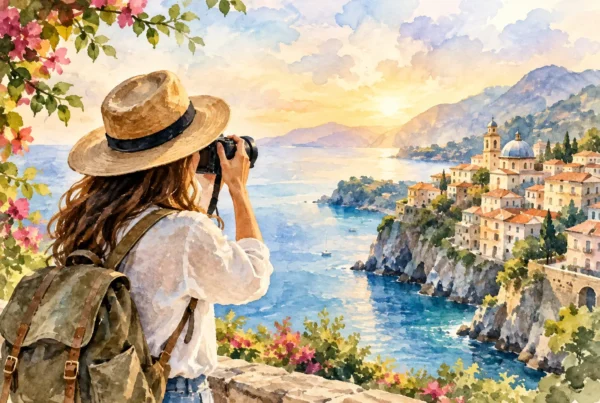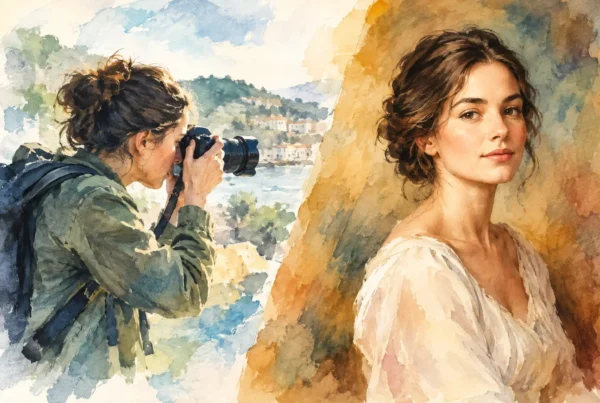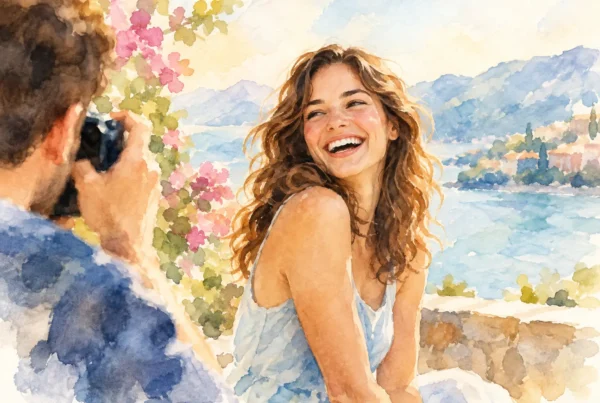

A photograph from a trip should bring you back to more than a view. It should recall the pause before a proposal, the way your child held your hand on a steep Porto street, or the quiet relief of finally being somewhere beautiful together. Fine art portraits are made for that kind of remembering – not for standing in front of a landmark and trying to look like someone else.
They are often mistaken for highly posed, overly polished images. The reality can be much more human. The strongest fine-art portraiture begins with observation: the light, the pace of the place, the small gestures between people, and the details that already belong to your story.
What makes fine art portraits different?
Fine art is not a filter, a preset, or a stiff pose with an expensive backdrop. It is an intentional way of seeing. Every choice, from the location and framing to the moment the shutter is pressed, is made to create an image with feeling, shape, and a sense of atmosphere.
That does not mean every frame needs to look serious. A windblown laugh beside the Douro, a child racing through a vineyard path, or a couple sharing a glass of wine as the sun drops behind the hills can be just as artful as a quiet, cinematic portrait. The difference is in the attention paid to what is real rather than what is expected.
For travelers, this matters because Portugal is not experienced in a studio. It happens while you wander cobbled streets, stop for coffee, lean into each other at a river viewpoint, or take in the scale of the terraced Douro Valley. A portrait session should leave room for those moments instead of interrupting them.
The best portraits start before the camera comes out
The most natural images rarely begin with the instruction to smile. They begin with a conversation. A photographer needs to understand why you are traveling, what you want to remember, whether you are celebrating something, and how comfortable you feel being photographed.
A honeymoon couple may want an unhurried walk through Porto at first light, when the streets are still quiet and the city feels entirely their own. A family may need space to move, snack, reset, and let children be children. Someone planning a surprise proposal needs a different kind of care: discreet location planning, a believable reason to be in the right place, and enough distance for the moment to unfold without interruption.
There is no single formula because people do not arrive with the same energy. Some couples are immediately playful. Others need ten minutes to forget the camera exists. Good direction meets you where you are. It might be as simple as walking slowly toward the light, talking to each other instead of looking at the lens, or taking a moment to notice the city around you.
Direction without performance
“No forced poses” does not mean no guidance at all. Left entirely alone, most people do not know where to put their hands, where to look, or how to relax their shoulders. The goal is gentle direction that gives you something natural to do rather than a pose to hold.
You may be asked to walk, pause, share a memory from the trip, or look at something in the distance together. These small prompts create movement and connection. They also allow a photographer to work with changing light and composition without making the session feel like a sequence of instructions.
There is a trade-off worth understanding. A fully candid approach can produce wonderful unpredictability, but it may not give you a few clear, beautifully composed images where everyone is visible. A more directed session creates consistency, though too much control can drain the life from it. The right balance is usually both: honest moments, shaped with enough intention to become lasting photographs.
Why place matters as much as expression
A meaningful portrait does not need a famous background in every frame. In fact, the images people return to most are often made a few streets away from the postcard view. A weathered doorway, tiled facade, shadowed arcade, or small patch of open sky can say more than a crowded landmark.
Porto offers this variety in a remarkably compact space. The city can be graphic and intimate one minute, then open onto the river the next. Early morning brings calm blue light across Ribeira and softer streets for walking portraits. Late afternoon can turn stone walls warm and give the Dom Luís I Bridge a dramatic presence without making it the whole story.
In the Douro Valley, the landscape changes the rhythm completely. Terraced vineyards invite a slower session. There is room to breathe, to take in the valley, and to let the day unfold around a wine tasting or private tour. Here, wide images can show the scale of the landscape, while close portraits keep the experience personal. Neither should overpower the other.
The practical consideration is timing. Golden light is beautiful, but it is not always the best choice for every traveler. Families with young children may be happier in the morning. A surprise proposal may depend on when a viewpoint is quieter. On a summer day, shade and comfort may matter more than chasing the last light. The best plan is one that serves the people in the photographs, not just the portfolio.
What to wear for portraits that still feel like you
Wear something that feels like a more considered version of yourself, not a costume. If you feel restricted, self-conscious, or unlike yourself, it will show. Comfortable shoes are especially wise in Porto, where beautiful streets often come with hills and uneven cobblestones.
Colors that work with the setting tend to photograph well: soft neutrals, earthy tones, deep blues, warm rusts, olive, cream, or a single rich color against stone and river views. Avoid trying to match perfectly. Coordinating is more natural than dressing in identical outfits, and a little texture – linen, knitwear, a flowing skirt, a structured jacket – can add depth without distraction.
For proposals and anniversary sessions, bringing one optional layer can be useful. A jacket, scarf, or change of shoes can quietly shift the look of a second part of the session. More importantly, it gives you choices if Porto’s weather changes its mind.
Let the photograph hold the imperfect parts, too
The images with the longest life are not always the technically tidy ones. A little wind in your hair, a child who refuses to stand still, a sudden burst of laughter, or the nervous seconds before someone says yes can become the frame that matters most.
Fine art portraits leave room for those imperfect parts because they are proof that you were there. They do not erase the travel day in favor of a fantasy version of it. They give shape to the real experience: the place, the people, the weather, the anticipation, and the connection.
That is why choosing a photographer is less about finding someone who can make you pose and more about finding someone who can pay attention. With more than fifteen years of visual-art experience, By RuPe approaches each session as a story already in motion, then creates the space for it to be seen.
Bring the outfit that feels like you, choose a setting that means something, and leave a little room in the plan for the unexpected. The moment does not need to be perfect to deserve a beautiful photograph.