
A family photo session can go quiet the moment someone says, “Everybody look here.” Children stiffen, adults wonder where to put their hands, and the image begins to feel less like a memory than a task. The best family posing alternatives replace that pressure with something much simpler: a reason to be together.
That matters even more on a trip. You did not come to Porto to spend an hour arranging yourselves into a version of family life that does not exist. You came to walk the cobbled streets, share pastries before lunch, take in the river views, and see your children notice a new place. Your photographs can hold that feeling without becoming a string of accidental snapshots.
Why traditional family poses often fall flat
A classic posed portrait has its place. Grandparents may want one frame where everyone is visible, looking toward the camera, and there is nothing wrong with making it. But when that is the entire session, the photographs can lose the small details that make a family recognizable: the child who runs ahead, the parent who always reaches for a hand, the private joke that breaks through at precisely the wrong moment.
Forced posing also asks families to perform under conditions that are rarely ideal. There may be jet lag, a toddler who has reached the end of their patience, strong sun, or a teenager who would prefer to disappear into their phone. Trying to control all of it usually creates more tension, not better photographs.
A documentary-minded session works differently. It gives everyone a loose framework, then leaves room for personalities to appear. The photographer still pays close attention to light, composition, background, and timing. The difference is that you are not asked to freeze inside that composition.
Family posing alternatives built around real interaction
The aim is not to pretend the camera is absent. Most people know it is there. The aim is to give your family something natural to do so you stop thinking about it every second.
Walk somewhere with a view
Walking is one of the easiest ways to create photographs with energy. A family might wander downhill toward Ribeira, cross a quiet stretch of pavement beside the Douro, or move through a tiled side street while talking about what comes next. The direction and pace can be gently guided, but the connection belongs to you.
A walk also gives children permission to move. They can hold a hand, race a sibling for a few seconds, stop to look at a doorway, or insist on being carried. Those changes create variety without asking anyone to invent a smile on command.
Give children a small mission
Children rarely respond to “stand still and be cute.” They respond to a game, a question, or a job that feels like their own. Look for a blue tile. Find the next yellow tram. Choose which way to turn. Whisper the silliest animal you can think of to your dad.
These prompts should not feel like a performance. They are simply a way to turn nervous energy into a real exchange. A child concentrating on a tiny discovery is often more expressive than a child looking directly at the lens.
Make room for the in-between moments
Some of the strongest frames happen before or after the moment you think is happening. A parent adjusts a small jacket. Two siblings compare snacks. Someone laughs after getting a direction wrong. Your child leans into you while waiting for the light to change.
These are not filler images. They are often the photographs that become more valuable with time because they show how your family actually moved through a day together.
Use touch, not choreography
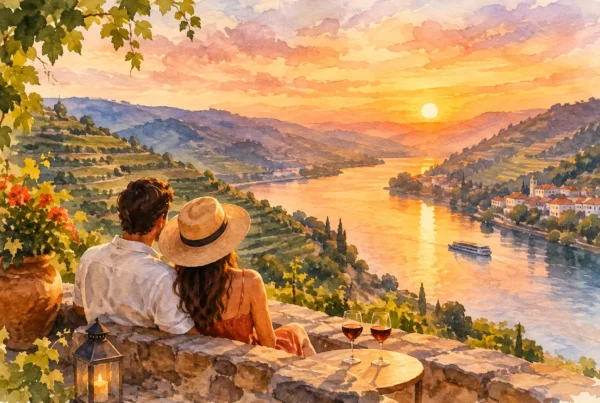
Touch brings a photograph to life, but it does not need to be arranged into a complicated formation. Sit close on a low wall. Let a child climb into your lap. Put an arm around your partner while you watch the river. Hold hands for a few steps, then let go naturally.
The difference is subtle but important. Instead of being told exactly where every shoulder and finger should go, you are invited into a moment of closeness. From there, small adjustments can help the image without interrupting it.
Let the location do some of the work
A beautiful setting should not become a backdrop you stand in front of and ignore. In Porto, the city offers texture and movement almost everywhere: patterned facades, worn stone steps, river wind, bright laundry overhead, and late-afternoon light moving across the hills.
In the Douro Valley, a family session can slow down even more. Terraced vineyards create space to walk side by side, while a viewpoint or a quiet road gives children room to breathe. If wine tasting or a private tour is part of the day, photographs can be made around the experience rather than pulled away from it for a separate, overly formal shoot.
Location is not a substitute for connection, though. A famous bridge cannot rescue a strained session. Sometimes a less obvious street with softer light and fewer people is the better choice because your family can settle into the moment.
What a little direction still does well
Natural does not mean unplanned. A good photographer notices when someone is hidden behind another person, when the light is too harsh, or when a background is competing with your faces. Gentle direction protects the image while keeping the experience relaxed.
You may be asked to turn slightly toward the light, walk more slowly, gather closer for one frame, or pause at a spot that gives the scene room to breathe. Those are not rigid poses. They are small invitations that make the most of what is already happening.
There is also value in taking one calm, camera-facing portrait. Think of it as an anchor image, not the whole story. Once it is done, everyone can return to moving, talking, and enjoying the place.
How to prepare without overplanning
The easiest preparation is practical. Choose clothing you can walk, sit, and carry a child in. Coordinate colors loosely rather than matching exactly. Soft neutrals, warm earth tones, faded blues, and simple textures often work beautifully against Porto’s stone and tile, but the priority is that everyone feels like themselves.
Plan around your family’s real rhythm. For young children, that may mean scheduling after a nap and bringing water plus a familiar snack. For older kids, it can mean involving them in the plan: a stop for gelato afterward, a place they want to see, or permission to choose one photo location. No schedule can guarantee a perfect mood, but a thoughtful one gives the day a better chance.
Most of all, release the idea that every image must look polished in the same way. A windblown hair, a child with crumbs on their shirt, or a burst of laughter can carry more truth than a flawless lineup ever could.
When posed portraits may still be the right choice
Family posing alternatives are not an argument against all structure. If you are celebrating multiple generations, marking an anniversary, or creating a photograph intended for a holiday card, a carefully arranged portrait can be meaningful. The key is to make it one part of the session rather than the atmosphere of the whole session.
It also depends on your family. Some children love instructions and enjoy creating a dramatic, editorial-looking frame. Some adults feel more comfortable with a clear starting point. A thoughtful session can move between guided portraits and spontaneous images, adjusting as everyone settles in.
The best photographs rarely ask your family to become more polished, more coordinated, or more photogenic than you are. They ask you to be present with one another in a place worth remembering. Bring comfortable shoes, leave a little room in the schedule, and let the real moments have time to arrive.