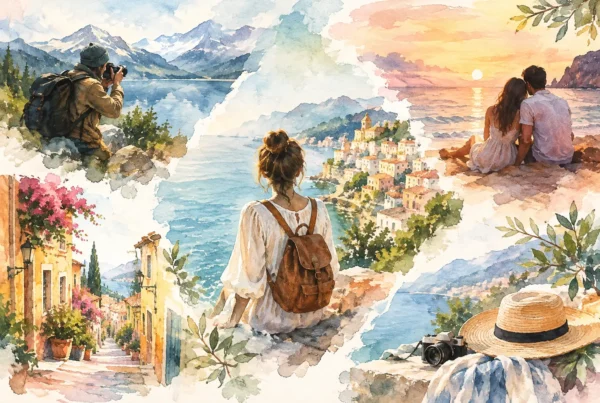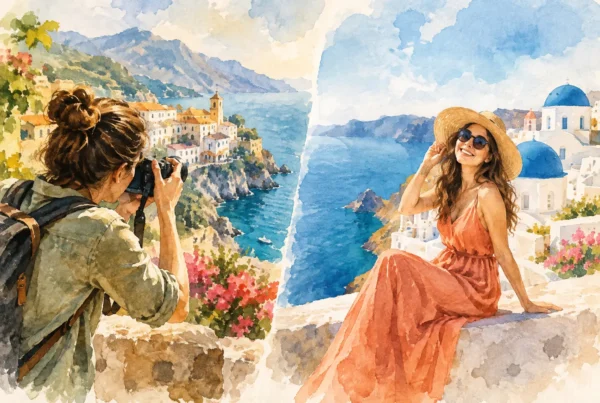

Your phone will come home full after Portugal. There will be tiled facades, pastel de nata, sunset from the river, a plate of something wonderful you meant to remember the name of. But professional photos versus smartphone memories is not really a contest about camera quality. It is about the difference between documenting what you saw and preserving how it felt to be there together.
A phone is brilliant for the in-between details. It catches the first view from a hotel balcony, the wine label you loved in the Douro, the crooked little street that made you stop. Those pictures have their place. Yet when you look back years later, they often reveal one person behind the camera and the other person waiting to be photographed. The shared experience is missing one of its main characters.
Your phone records the trip. A photographer sees the story.
Smartphones have made everyone more attentive to their surroundings. That is a good thing. Their cameras are remarkably capable in bright daylight, easy to use, and always close at hand. For a spontaneous moment, there is no better tool.
But a meaningful photograph asks for more than sharpness. It asks who is in the frame, what is happening around them, and whether the image carries a little of the mood that made the moment matter. A professional photographer notices the pause before a laugh, the way a hand reaches for another without being directed, or the quiet breath taken before a proposal. Those are small gestures, but they are where memory lives.
For couples traveling in Porto, that might mean walking side by side beneath the soft morning light of Ribeira rather than standing squarely in front of a landmark. For a family, it might be children racing ahead on cobbled streets while the adults catch up, smiling despite themselves. The strongest images rarely come from asking people to perform happiness. They come from giving real connection enough room to happen.
Professional photos versus smartphone memories: the real differences
The practical difference is not simply that a professional has a better camera. It is that they arrive with experience, visual intention, and attention available for you.
When you rely on your phone, someone has to hold it, check the composition, find a clean background, set a timer, and hope nobody blinks. That work can interrupt the very moment you wanted to keep. A photographer handles the moving parts quietly, so you can stay present with your partner, your children, or your own experience of the city.
Light matters, too, especially in a place with so much texture. Porto can give you bright river reflections, deep shadows between old buildings, misty mornings, and a warm final hour that makes stone walls glow. A phone may flatten that contrast, over-brighten a face, or turn a dramatic scene into something merely adequate. A professional works with the available light and chooses angles, timing, and locations that make it feel intentional.
Then there is perspective. A traveler sees a beautiful bridge. A photographer sees the bridge, the river, the space around you, and the small human moment that gives the scene scale. The goal is not to make you look pasted onto Portugal. It is to create photographs where you belong in the place.
Why candid photographs require more care, not less
“Natural” does not mean a photographer simply follows you around and hopes for the best. The most relaxed-looking images are often supported by thoughtful planning.
A good session begins with understanding your pace. Some couples want a slow morning with coffee and river views. Others want a walk that moves through lively streets, viewpoints, and hidden corners. A family may need a route with room for children to explore and pauses that do not feel like a lesson in sitting still. A solo traveler may want portraits that feel editorial but still unmistakably personal.
That planning creates space for spontaneity. You may receive a gentle prompt rather than a rigid pose: walk toward the light, tell each other the story of your first trip together, look out at the view for a moment. The instruction is minimal because the objective is not to manufacture an expression. It is to create an opening for something real to surface.
There are moments when a more directed portrait is useful. Perhaps you want one beautiful image for an announcement, a holiday card, or the wall at home. There is nothing wrong with looking at the camera. The difference is that it should feel like you, not like a stranger’s idea of what a vacation portrait should be.
The value of being in the frame
This is the part travelers often underestimate until after the trip. In years to come, you may care less about proving that you visited a famous viewpoint and more about seeing the two of you there: younger, tired from walking, delighted by the view, wearing the outfit you almost did not pack.
For parents, the value is even more immediate. Most family albums contain hundreds of photographs of children and very few that show the whole family together without a rushed timer or an extended arm at the edge of the frame. A professional session gives parents permission to participate. You do not have to be the organizer, the photographer, and the person making everyone smile at once.
For solo travelers, being in the frame is not vanity. It is evidence of a chapter you chose for yourself. A considered portrait can hold the confidence, curiosity, or quiet reset that brought you to Portugal in the first place.
Some moments should not be managed through a screen
A surprise proposal is one of them. The person planning it has enough to think about: the right timing, a meaningful location, the ring, the nerves, and how to make the day feel ordinary until it suddenly is not. Asking a passing stranger to take a phone photo is a gamble. Setting up a phone in advance can make the moment feel arranged before it has begun.
Discreet professional coverage changes the experience. The photographer can help plan where to stand, when the light will be most beautiful, and how to approach without giving anything away. Then they step back. The proposal belongs to the two people in it, not to the camera.
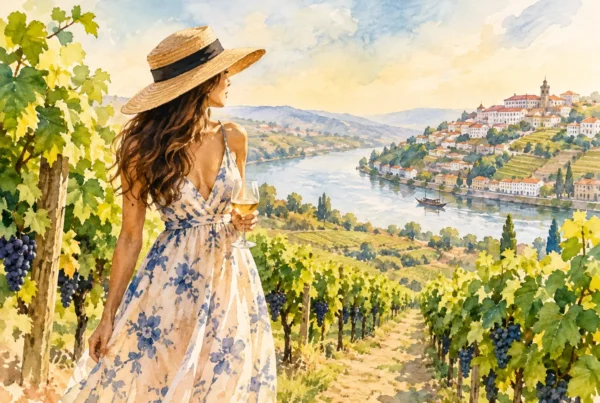
The same is true of a private wine day in the Douro Valley. Terraced vineyards, winding roads, and a long table in the afternoon sun deserve more than a sequence of snapshots. But the photographs should never overtake the day. The best ones let you taste the wine, take in the valley, and be surprised by the beauty of it all.
What a professional session cannot replace
Your phone still matters. Keep taking the imperfect pictures: the train window, the menu with a wine stain, the blurry dance after dinner, the view from your seat. These are the loose threads of a trip, and they are often delightful.
Professional photography is not a replacement for those casual records. It is the considered collection that holds the larger feeling together. Think of it as choosing a few hours when nobody needs to manage the memory-making. You simply experience the place and the people you came with.
It also is not about chasing a version of travel designed for social media. If a photograph is made only to look impressive to people who were not there, it can quickly feel empty. The more lasting question is simpler: when you return to this image, will you recognize the life you were living in it?
Choosing the right kind of photographer
Style matters as much as skill. Before booking, look for work that shows people moving, reacting, and relating to one another, not just a gallery of perfect locations. Notice whether faces look comfortable. Notice whether each couple seems to have a distinct presence, rather than being placed into the same pose.
Local knowledge is valuable when it serves your experience rather than a checklist. A photographer who understands Porto’s shifting light and quieter corners can steer you away from crowded, predictable spots without making the session feel overly planned. They can also make an iconic location feel personal by arriving at the right time or seeing it from a less obvious angle.
Most of all, choose someone you can imagine spending time with. The camera is sensitive to discomfort. Warm direction, patience, and genuine observation do more for a photograph than a long list of poses ever could.
Bring home the phone photos, too. Let them remind you of the small, funny, unpolished parts of the journey. But make room for a few images where you are fully there, together, held in the color and light of a place that changed your ordinary days for a while.