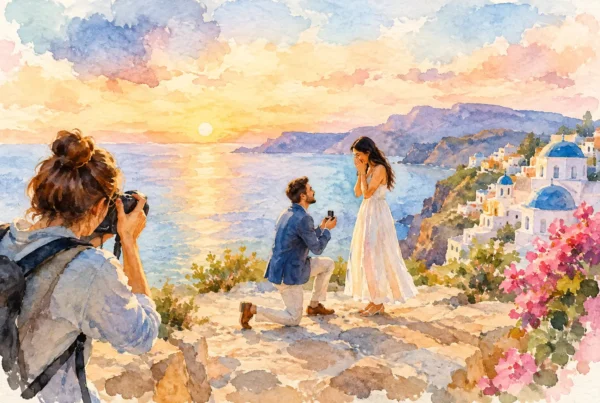

A child spots a tram rolling down a Porto street and suddenly wants to run. Someone laughs because the pastel de nata has cracked in the bag. Parents look at each other for one quiet second, relieved to be somewhere beautiful together. Are unposed sessions good families? For many, they are the difference between photographs that document a trip and photographs that bring the feeling of it back.
An unposed family session is not a free-for-all, and it is not a photographer standing far away hoping something happens. It is a more natural way of making portraits: gentle direction, room to move, and attention to the small interactions that cannot be repeated on command. For families traveling in Portugal, that often makes more sense than lining everyone up in front of a landmark and asking children to smile for the tenth time.
Are Unposed Sessions Good for Families?
Usually, yes – especially when your family values photographs that feel like you. Children do not need to perform happiness for the camera, and adults do not need to pretend they are comfortable in a pose that feels unfamiliar. The session can hold the real rhythm of your group: playful, quiet, affectionate, curious, a little chaotic.
That does not mean every image will be accidental. An experienced photographer sees the light, chooses a setting with space to breathe, and gives simple prompts that create connection rather than stiffness. You might be asked to walk together, tell your child a secret, pause by a river view, or let everyone choose something to look at. The result still has shape and intention, but it does not look manufactured.
For travelers, this approach has another advantage. You are not stepping out of your holiday to attend a formal photo appointment. The photography becomes part of the experience: wandering cobbled streets, stopping for a view over the Douro, sharing a snack, or watching the city turn gold near sunset.
Why Children Respond Better to Movement
Children are often the clearest test of whether a session feels comfortable. A toddler does not care that a view is iconic. A school-age child may cooperate for a few minutes, then become more interested in a puddle, a pigeon, or the sound of a street musician. Teenagers may be willing, but understandably wary of anything that feels too staged.
Unposed photography works with that reality instead of fighting it. Movement gives children something genuine to do. Walking, climbing a small set of steps, holding hands, racing toward a parent, or examining a tile-covered wall can release the pressure that comes with being watched. Their expressions change when the goal is not simply to smile.
This approach also leaves room for their personalities. The serious child, the endlessly energetic child, the one who needs time to warm up, and the teenager with a dry sense of humor all deserve photographs that feel accurate. A polished gallery should not erase those differences in pursuit of perfect behavior.
Of course, “natural” does not mean ignoring a child who is overwhelmed or hungry. A good session has flexibility built in. Sometimes the best decision is to take a break, slow down, or let the plan change. Often, the image parents end up loving most comes just after everyone stops trying so hard.
The Trade-Off: Less Control, More Truth
Families considering candid photography often have one understandable concern: Will we still get a photograph where everyone is looking at the camera?
You can. A few gently guided, looking-toward-the-camera portraits can be part of an unposed session, particularly if they matter to you or to a grandparent waiting at home. The difference is that they are not the entire point of the experience. They are made quickly, without turning the session into a series of instructions.
The trade-off is that an unposed gallery may include a little wind in someone’s hair, a child looking away, or a moment of laughter where no one is perfectly composed. Those details are not flaws. They are often the evidence that the photograph belongs to your actual family, on an actual day.
If your priority is a formal holiday-card portrait with every face square to the lens, a traditional session may suit you better. If you want the close handhold, the glance between siblings, the way your child curls into your shoulder when tired, candid work is often the stronger choice. Neither preference is wrong. The important part is choosing the kind of memory you want to keep.
What the Photographer Is Doing When It Looks Effortless
The best unposed family sessions can appear wonderfully simple. Behind that ease is careful observation.
Light matters. Porto’s narrow streets can shift quickly from deep shadow to bright sun, while the riverfront can glow softly late in the day. A photographer who knows the area can choose a route and timing that lets your family move naturally without constantly being placed and repositioned.
So does pacing. A family with a baby may need a slower, shorter walk than a family with older children. A jet-lagged child may be happiest in the morning, while a family planning dinner by the river may prefer the warmth of late afternoon. A session should meet your day where it is, not force your travel plans to bend around a rigid formula.
There is also an art to knowing when to step in. A small adjustment can make a meaningful difference: moving two feet away from a crowded corner, turning toward softer light, or suggesting that parents look at each other rather than the camera. These are not forced poses. They are quiet choices that make a spontaneous moment easier to see.
How to Help Your Family Feel Like Themselves
You do not need to prepare a performance. The most useful preparation is practical: choose a time when nobody is likely to be starving, allow extra time to arrive, and avoid scheduling the session directly after a long drive or flight if you can.
Wear clothes that let everyone move comfortably and feel like themselves. Coordinating colors can look beautiful, but identical outfits are not necessary. Soft neutrals, warm tones, and layers that work with the season tend to sit naturally against Porto’s stone, tile, and river light. More importantly, avoid clothing your children hate. No photograph is worth a battle over an itchy collar.
Bring water and one simple snack, but do not turn treats into constant bargaining. Let children know they will be walking and exploring with someone friendly who has a camera. You can tell them there is no need to be perfect. That message changes the atmosphere before the session even begins.
Parents have a role, too: try to stay present. When a child wanders a little, laughs too loudly, or refuses a suggestion, take a breath. The more you can respond with warmth instead of correction, the more relaxed everyone becomes. Your children will remember the feeling of being with you far longer than they will remember being photographed.
A Family Story Is Bigger Than a Smile
A travel photograph can show where you went. A good family photograph can show who you were there together.
Years from now, the view of the Dom Luís I Bridge may bring back the trip. But the image that stays closest may be the one of your child’s hand tucked into yours, your partner laughing as the wind catches their jacket, or all of you walking toward dinner as the city lights begin to appear. These are not filler moments between portraits. They are the story.
By RuPe approaches family photography with that kind of attention: no forced poses, just real moments honestly captured with an eye for place, light, and connection. The goal is not to make your family look like someone else’s idea of perfect. It is to leave you with photographs that feel true when the trip is already far away.
Choose the session that gives your family permission to be present. The best photographs usually begin there.