
A beautiful view does not automatically make a natural photograph. Most people become aware of their hands, their smile, and every angle of their body the moment a camera appears. Learning how to pose naturally is less about memorizing poses and more about having something real to do, someone to connect with, and enough space to forget the camera is there.
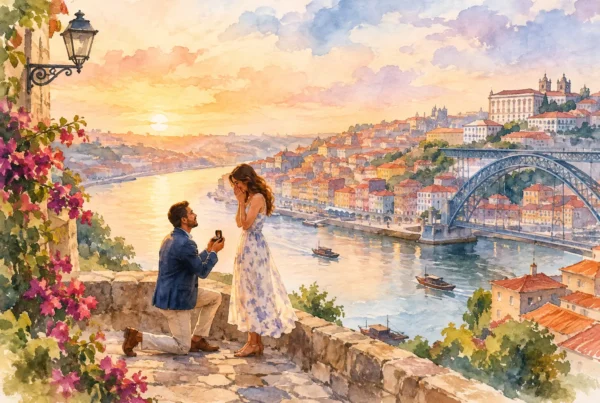
The goal is not to look accidental. It is to look like yourself on a very good day: present, relaxed, and fully part of the place you came to see. In Porto, that might mean sharing a quiet look beside the river, walking a cobbled street before dinner, or pausing as late light reaches the facades above Ribeira. The photograph becomes stronger when the moment leads and the pose quietly follows.
How to Pose Naturally Starts Before the Camera
Natural images begin with a small shift in expectation. You do not need to arrive knowing what to do with your body. In fact, trying to perform for the camera often creates the stiffness people hope to avoid. A good photographer will guide you, but the best guidance feels more like a conversation than an instruction.
Give yourself permission to move slowly. Take a breath before the first photograph. Look around, notice the temperature, the sounds, the person beside you. When your attention is fixed on whether you look good, your expression can tighten. When it returns to the experience, your face and posture tend to soften on their own.
Clothing helps, too. Choose something you can walk, sit, lean, and breathe in. A dress that needs constant adjusting or a jacket that feels too formal can make you guarded. You do not need to dress casually, but you should feel like yourself in what you wear. The camera notices comfort.
Let Movement Replace the Pose
Standing perfectly still is difficult for almost everyone. Movement gives your body a reason to settle into a shape without forcing it. Instead of asking, “What should I do?” try a simple action: walk toward each other, cross the street together, adjust a sleeve, look out over a view, or stop to take in a detail you would genuinely notice.
The movement should be unhurried. Fast walking can look staged, while slow movement creates small changes in your hands, shoulders, and expression. A photographer can capture the in-between moments: the glance before a laugh, the hand reaching for another hand, the second after you have stopped walking.
Give your hands a purpose
Hands are often the first thing people worry about, largely because they become awkward when they are left hanging without a reason. Let them participate in the moment. Hold your partner’s hand. Rest one hand lightly in a pocket. Touch the edge of a coat, carry a small bouquet, or place a hand on someone’s arm.
The key word is lightly. Pressing, gripping, or flattening your hand against your body can look tense. Think of your hands as resting, not performing. If you are unsure, let them fall naturally for a moment and make a small adjustment only when prompted.
Let your face react instead of smiling on command
A constant smile rarely feels natural, even when it is genuine. Give your expression somewhere to go. Look at your partner, then away toward the street or river. Talk about the first thing you did that morning. Remember the meal you are excited to have later. A softer expression, a half-smile, or a thoughtful look can be every bit as warm as a broad grin.
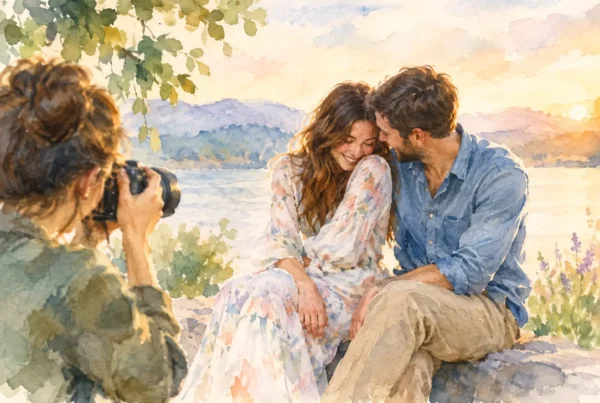
For couples, closeness matters more than matching smiles. Stand near enough that your bodies have a relationship to one another. Turn slightly inward. Let a shoulder touch. If a kiss feels right, take your time getting there rather than rushing to the final moment. Often, the approach is the photograph.
Use the Location as Part of the Direction
The best travel portraits do not place people in front of a landmark and ask them to prove they were there. They let the location shape the image. A narrow Porto street invites a slow walk and a shared conversation. A viewpoint above the Douro calls for stillness, distance, and room to take in the landscape. Terraced vineyards make sense for wandering, pausing, and letting the lines of the valley lead your eye.
This is why location matters beyond the background. A setting with texture and atmosphere gives you something to respond to. You can lean against an old wall, watch boats pass beneath a bridge, or step into a patch of golden light. Those choices create photographs with a sense of place, not just a recognizable backdrop.
There is a trade-off, though. The most famous spot is not always the most relaxed one. Busy areas can be full of people, noise, and phones held in the air. Sometimes a quieter corner nearby creates a more intimate image. A photographer with local knowledge can balance the iconic view with a place where you have room to be yourselves.
Small Adjustments Make a Real Difference
Natural does not mean unplanned. The camera sees details that everyday conversation does not: a raised shoulder, a chin pulled too far back, a hand turned directly toward the lens. Small adjustments can make a large difference while keeping the image true to you.
Try shifting your weight onto one leg rather than standing evenly on both feet. Angle your body slightly instead of facing the camera squarely. Lengthen through the back of your neck and drop your shoulders as you exhale. These are not tricks to change who you are. They simply create ease and shape.
It can also help to avoid looking into the lens for every frame. Eye contact with the camera has its place, especially for a clean portrait, but it is only one kind of image. Looking at your surroundings, your partner, or the light behind a building creates a more observational feeling. The result can feel less like a photoshoot and more like a memory with exceptional attention paid to it.
Posing Naturally as a Couple, Family, or Solo Traveler
Each kind of session needs a different rhythm. Couples usually look most at ease when they are given a shared action instead of separate poses. Walk close together, tell each other something quietly, or take a moment to look at the same view. Do not worry if you laugh halfway through. That is often the point.
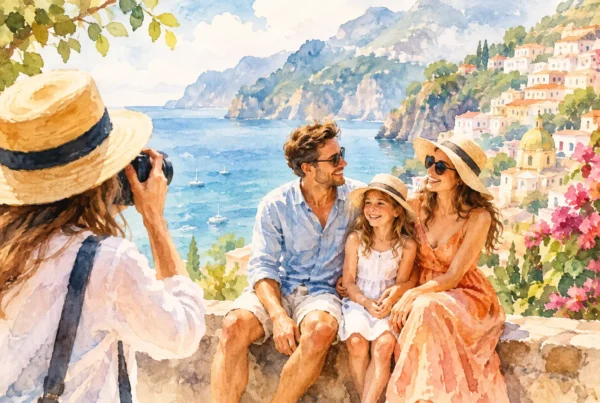
For families, trying to make every person look at the camera at once can become exhausting. Children need room to move, investigate, and occasionally ignore the plan. A parent crouching to speak with a child, siblings walking ahead, or a hand held tightly during a busy street crossing can tell a truer story than a perfectly arranged line of faces.
Solo travelers can use the environment as a companion. Walk through the frame, pause at a railing, sit at an outdoor table, or look up at an architectural detail. You do not have to project confidence every second. Quiet, reflective photographs can feel especially powerful when they are made in a place that means something to you.
Trust the Quiet Moments
There may be a few seconds during a session when you think nothing is happening. You have stopped walking. You are waiting for a passerby to move. You are fixing your hair, catching your breath, or simply standing beside someone you love. Those pauses are often where the performance disappears.
A natural pose is not a pose you get exactly right. It is a moment where your body has settled, your attention is somewhere real, and the photograph has room to hold both you and the place around you. Bring curiosity rather than a rehearsed version of yourself, and let the camera meet you there.